Index of content
Modern fisheries monitoring relies on a combination of technologies to provide a complete picture of vessel activity at sea. Two of the most widely used tools for data streams are the Automatic Identification System (AIS) and the Vessel Monitoring System (VMS). While these systems often appear similar on the surface as both provide vessel positions, but they serve different purposes, operate under different rules, and offer different levels of reliability for monitoring and compliance.
In practice, AIS and VMS are complementary rather than interchangeable. Understanding how they work together helps fisheries authorities, coast guards, and monitoring centres strengthen situational awareness and improve decision-making.
What AIS Does Well
AIS is a broadcast system originally designed for collision avoidance and maritime safety. Vessels transmit their identity, position, course, and speed to nearby ships and coastal receivers, and increasingly to satellites.
AIS provides high-frequency position updates, often every few seconds to minutes, and is widely used by commercial vessels for traffic awareness, port management, and maritime safety. Its coverage is further enhanced by satellite AIS providers, making it valuable for understanding regional activity patterns. However, AIS transmissions can be switched off, manipulated, or lost in congested areas, and because the system was not designed as a regulatory tool, it cannot be relied on for fisheries compliance on its own.
What VMS Does Better
VMS is a secured, tamper-resistant reporting system specifically designed for fisheries monitoring and control and is mandatory for many fishing vessels under national and RFMO regulations. It provides encrypted and authenticated position reporting, cannot be easily disabled without detection, and is fully compliant with national and international regulatory requirements. VMS is tightly integrated with licensing, catch reporting, and monitoring rules and is used by Fisheries Monitoring Centres (FMCs) worldwide as a trusted source for law enforcement and regulatory verification. Position reports are typically transmitted every 30 minutes to two hours, depending on regulation, less frequent than AIS, but far more reliable for compliance purposes.
Why Fisheries Monitoring Centres Use Both AIS and VMS
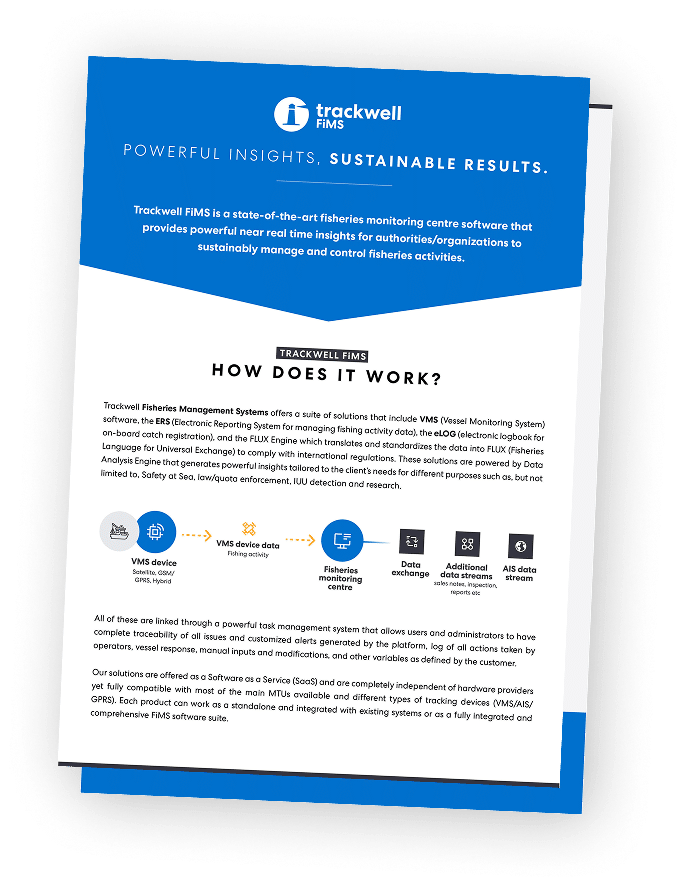
When AIS and VMS data are combined in systems like Trackwell FiMS, Fisheries Monitoring Centres gain a much clearer and more reliable operational picture. AIS provides high-frequency position updates that help reveal movement patterns, interactions with other vessels, and short-term behaviour between VMS reports, while VMS delivers secure, authenticated positions that can be trusted for regulatory and enforcement purposes.
Using both sources together allows FMCs to cross-check vessel activity, identify gaps or inconsistencies, and maintain situational awareness in busy or shared waters where fishing vessels operate alongside commercial traffic. The combination is also valuable for search and rescue operations, where AIS offers rapid updates and VMS provides verified last-known positions for planning and coordination.
AIS on its own is not sufficient for compliance, as it can be switched off or manipulated and does not meet legal reporting requirements. VMS, while secure and trusted, benefits from the additional resolution and traffic context that AIS provides. For this reason, modern FMCs increasingly rely on an integrated view of both systems.
Trackwell FiMS is designed to bring these data sources together in a single operational platform, allowing authorities to view and analyse VMS and AIS tracks side by side, detect anomalies, and place vessel activity in its environmental and regulatory context. By combining the strengths of both technologies, FMCs achieve a more complete, accurate, and actionable understanding of what is happening at sea.
The Power of AIS and VMS Vessel Data Combined
AIS and VMS are powerful tools, but neither tells the whole story on its own. Used together, they provide monitoring centres with the situational awareness, reliability, and compliance insight needed to protect its Extended Economy Zones, national waters and support sustainable fisheries.
Modern fisheries management is increasingly about data gathering, and combining AIS with VMS is one of the most effective ways to achieve that. Systems like Trackwell FiMS ensure that authorities get the best of both worlds in a seamless, operationally ready platform.