At ICES ASC 2026, Trackwell presented ongoing research into one of the most challenging problems in fisheries monitoring: how to transform vessel position reports into meaningful behavioural information that can be identified, analysed, and ultimately predicted.
The concept sounds straightforward. Modern monitoring systems collect vast amounts of AIS and VMS position data. However, turning these position reports into reliable behavioural insights is far more complex than simply applying a machine learning model. A key theme of our presentation was that moving from theory to practice requires adapting analytical methods to real-world conditions. Operational data is often incomplete, irregular, delayed, or contains errors. AIS messages may arrive out of order, contain missing values, or be transmitted at inconsistent intervals. Before selecting an Al model, it is therefore essential to understand what information is being provided to that
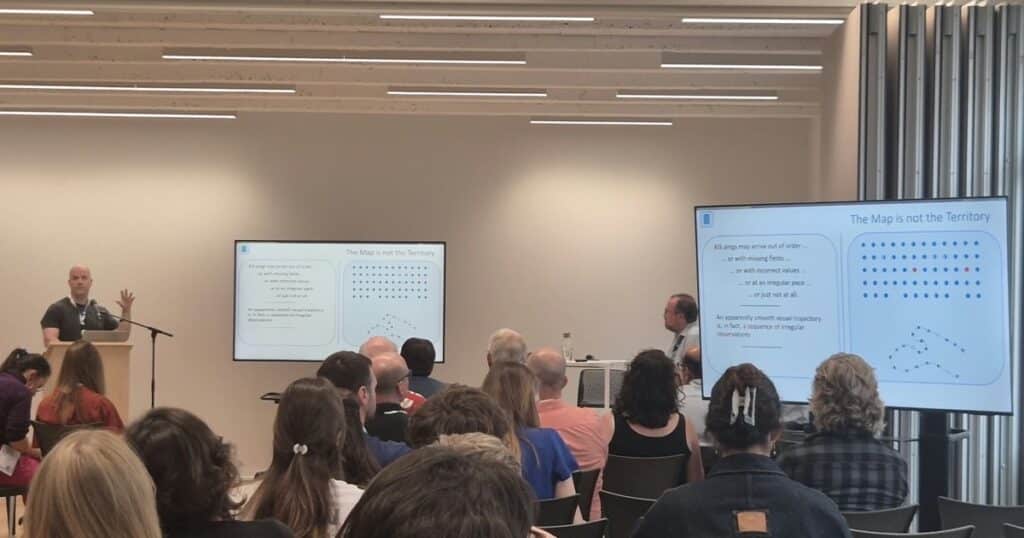
A key focus of our research was understanding how vessel behaviour can be identified from position data. This is challenging because individual AIS messages often provide too little context, while fixed time periods can combine multiple activities into a single observation. To address this, we explored adaptive segmentation techniques and unsupervised machine-learning methods to identify recurring movement patterns. Using a multi-stage clustering approach, we were able to uncover behavioural groups that would otherwise remain hidden in the data. The research also highlighted an important operational reality: vessel behaviour is constantly evolving, and real-time systems must make decisions based on incomplete information. As a result, AI-driven predictions need to account for operational uncertainty and additional real-time data becomes available.
The central takeaway from the research is that successful AI systems rely on far more than advanced models alone. Data quality, information representation, deployment considerations, and transparency around uncertainty are all critical to producing operationally useful results. Ultimately, the goal is to help fisheries authorities move beyond simply displaying vessel positions on a map and towards understanding vessel behaviour in a way that improves monitoring, compliance, resource management, and decision-making.
As AI capabilities continue to advance, the most valuable systems will be those that move beyond the simple generation of vast predictions and manage instead to deliver clear insights that operations can trust. That is the direction Trackwell continues to pursue through its ongoing AI and analytics initiatives.