Index of content
Illegal, Unreported, and Unregulated (IUU) fishing remains one of the most significant threats to global fish stocks, marine ecosystems, and the economic livelihoods of coastal nations. While regulatory frameworks and monitoring tools have evolved considerably over the past decades, the growing scale and complexity of global fisheries demand more advanced approaches to monitoring, analysis, and enforcement.
At Trackwell, we believe the next major step in fisheries monitoring lies in integrating data at scale and applying artificial intelligence (AI) and machine learning (ML) to turn information into actionable insight.
From Monitoring to Understanding
Modern fisheries monitoring relies on a wide range of data sources. These include Vessel Monitoring Systems (VMS), Electronic Reporting Systems (ERS), observer programmes, inspection reports, landing and sales records, and satellite-based surveillance. Each source provides valuable insight, but when viewed in isolation, none can offer a complete picture of what is happening at sea.
Fisheries Monitoring Centres (FMCs) are increasingly challenged by the volume, variety, and speed of incoming data. Even with experienced personnel, manually correlating vessel positions, catch reports, licenses, inspections, and satellite observations in real time is extremely difficult.
The question facing the industry is no longer how to collect more data, but how to use the data already available more effectively.
Integrated Monitoring as the Foundation
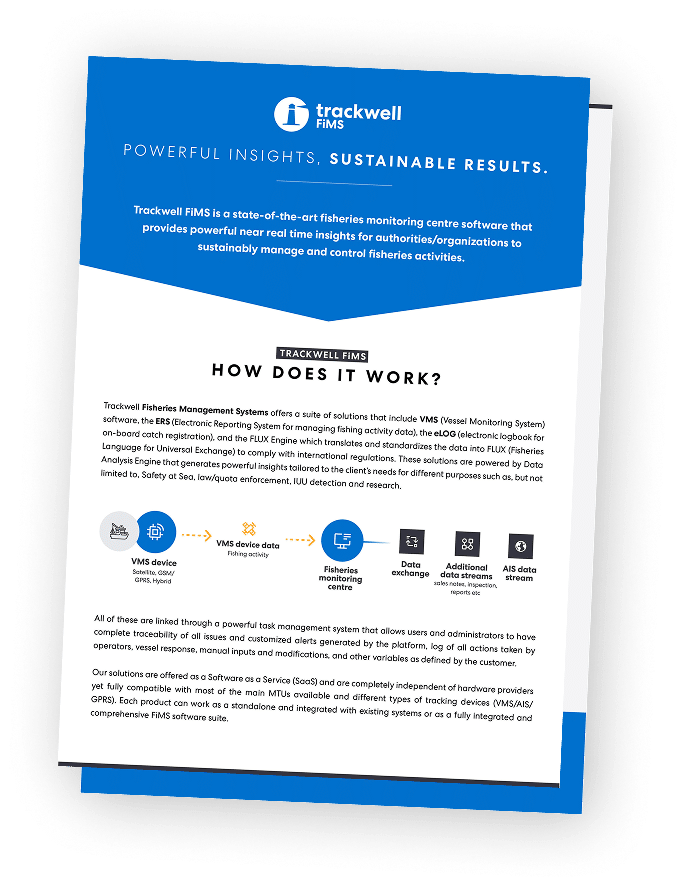
Fisheries Monitoring Systems (FMS), built primarily on a Vessel Monitoring System (VMS) and Electronic Reporting System (ERS), already provide the operational backbone for modern fisheries control. These systems enable authorities to track vessels in near real time, verify fishing activity, and ensure compliance with national and international regulations.
Trackwell FiMS supports large ocean areas through deployments with fisheries authorities and regional organizations including Iceland, NEAFC, FFA, WCPFC, Australia, Malta, Greece, Cyprus, and the Falkland Islands. These implementations demonstrate how integrated monitoring platforms can support both national surveillance and international cooperation.
The introduction of the FLUX (Fisheries Language for Universal Exchange) standard has further strengthened this foundation. By standardising how fisheries data is structured and exchanged across domains — such as vessel positions, fishing activity, licenses, and authorisations — FLUX enables seamless cross-border data sharing and improves interoperability between systems.
Multi-Source Data Fusion: The Next Frontier
As data volumes continue to grow, the real challenge lies in making sense of information across multiple sources simultaneously. Effective monitoring increasingly depends on the ability to combine and cross-check data such as:
- VMS and AIS tracks to reconstruct vessel movement histories
- Catch and fishing activity reports
- Licenses and authorisations
- Inspection and Port State Measures (PSM) data
- Landing, sales, and transhipment records for traceability
- IUU vessel lists and blacklists
- Satellite imagery to validate vessel presence and detect non-reporting vessels
- Global vessel registries to support identity verification and combat flag hopping
When analysed together, these data sources provide a much stronger basis for detecting inconsistencies, identifying high-risk behaviour, and prioritising enforcement efforts.
Applying AI and Machine Learning to Fisheries Monitoring
To unlock the full potential of integrated data, Trackwell is developing a Data Analysis Engine (DAE), a new module within the Trackwell FiMS platform that applies AI and machine learning to fisheries monitoring.

The goal of the DAE is not to replace human expertise, but to support monitoring officers by automating large-scale analysis, detecting anomalies in real time, and generating risk indicators that help focus attention where it matters most.
Key AI-driven capabilities under development include:
- Transhipment detection, to identify covert transfers at sea
- Trail and gear analysis, to highlight illegal activity or use of banned equipment
- Catch per unit effort (CPUE) analysis, supporting both compliance and stock assessment
- Predictive alerts, flagging potential non-compliance before it escalates
By shifting routine data scanning to automated systems, FMC personnel can concentrate on investigation, verification, and decision-making, where human judgement is most valuable.
The Future of AI Fisheries Monitoring
The future of fisheries monitoring depends on global data cooperation, advanced analytics, and intelligent digital tools. Multi-source data fusion and AI-driven analysis offer a scalable way to enhance situational awareness, improve enforcement efficiency, and support evidence-based policy decisions across different regions and fleet types.
Trackwell is committed to developing practical, operational technologies that help authorities combat IUU fishing, manage fisheries sustainably, and safeguard marine resources for future generations, by turning data into insight, and insight into action.